Cybersecurity & Resilience

Trust is designed.
Continuity is demonstrated.

Cybersecurity strategy and SOC, MDR and Cyber Fusion Center models connecting detection, response and continuity. With AI, automation and business context, from SAP to the cloud.

Protection connected to your business.
From risk to execution.

Choose how to strengthen your defense

SOC, MDR or CFC.
Understand what you need.

Each model addresses a different need. The choice depends on your team, your platforms and the operational responsibility you want to share or delegate.

SOC

Security Operations Center
People, processes and technology

Organize your security operations.

A function bringing together people, processes and technology to monitor, investigate and manage incidents.

  • Centralized signals and analysis.
  • Detection use cases and procedures.
  • Escalation and response coordination.

When it fits: you need to build, modernize or complement your security operations center.

Let's discuss SOC →

MDR

Managed Detection and Response
Specialist detection and response

Delegate detection and response.

A service delivered by specialists who investigate threats, hunt for malicious activity and execute or coordinate authorized responses.

  • Investigation and threat hunting.
  • Containment within the agreed scope.
  • Incident follow-through and evidence.

When it fits: you need specialist capacity to investigate and respond, complementing or supporting your team.

Explore the scope of MDR →

CFC

Cyber Fusion Center
Integrated cyber defense

Connect defense with the business.

A model integrating security operations, intelligence, exposure management and response with IT, risk and continuity.

  • Shared intelligence and context.
  • Automation across tools and teams.
  • Priorities based on operational impact.

When it fits: you need to coordinate functions and platforms that currently make decisions separately.

Explore the integrated model →

These models can work together: a SOC can incorporate MDR, and a Cyber Fusion Center can integrate both. Automation can support any of them.

The question that matters

Where would losing control cost you most?

Risk becomes tangible when it affects a payment, a delivery or a decision. Explore how a technical exposure can reach a critical operation.

Illustrative scenario

Inappropriate access can become an incorrect payment.

  1. 01 · Exposure

    Account with excessive privileges

  2. 02 · Process

    Bank details changed

  3. 03 · Impact

    Funds sent to another account

Controls worth reviewing

  • Privileged access and stronger authentication.
  • Separation of modification and approval.
  • Traceable changes to suppliers and payments.

Expected evidence: current authorizations, verifiable approvals and traceable changes.

Our capabilities

One view of risk.
Controls that work together.

We align executive priorities, architecture and operational responsibilities to turn findings into an improvement program.

01

Strategy, risk and governance

Prioritize exposures that threaten the business and connect investment, accountability and control evidence.

What the work should establish

A risk map, remediation priorities, accountable owners and reporting criteria for leadership.

02

Identity and access

Control who can do what, with which privileges and for how long, inside and outside your organization.

What the work should establish

Access lifecycle, roles, segregation of duties, privileges and periodic reviews.

03

SAP and enterprise systems security

Connect authorizations, interfaces and changes with the financial, logistics and operational processes they need to protect.

What the work should establish

A coordinated review of critical roles, technical accounts, integrations, changes and dependencies across the SAP environment.

04

Cloud architecture and data protection

Make access boundaries, configurations and responsibilities for data and workloads visible.

What the work should establish

Identity, configuration, exposure, logging and data protection controls across AWS, Azure and hybrid environments.

05

Readiness, response and recovery

Define how to contain an incident, coordinate decisions and recover services in the order the business needs.

What the work should establish

Owners, escalation paths, response procedures, recovery priorities and exercises with documented results.

06

AI governance and security

Define which information AI can use, which actions it can execute and where human intervention is required.

What the work should establish

Bounded use cases, permissions, data handling, approvals, traceability and criteria for stopping automation.

What MDR should deliver

From a suspicious signal to a verifiable response.

A detection and response service should connect technology, expert investigation and concrete actions, with clear responsibilities from day one.

01 · VISIBILITY

Detection across platforms

Correlation of endpoint, identity, email, cloud and enterprise system signals, based on available telemetry.

02 · INVESTIGATION

Analysis with context

Incident validation, activity sequence, affected assets and potential business impact.

03 · ANTICIPATION

Threat hunting

Proactive searches for malicious activity based on hypotheses, intelligence and evidence from the environment.

04 · RESPONSE

Authorized containment

Agreed actions and escalation paths, with a record of who decided, what was done and the outcome.

05 · IMPROVEMENT

Detections that evolve

Tuning rules and procedures, reducing noise and validating coverage against relevant threats.

06 · ACCOUNTABILITY

Follow-through to closure

Remediation coordination and coverage, investigation and containment metrics to evaluate the service.

Operating hours, including a 24×7 option, monitored sources, response permissions, forensics and recovery support are scoped and agreed for each service.

Cyber Fusion Center

One threat.
A coordinated response.

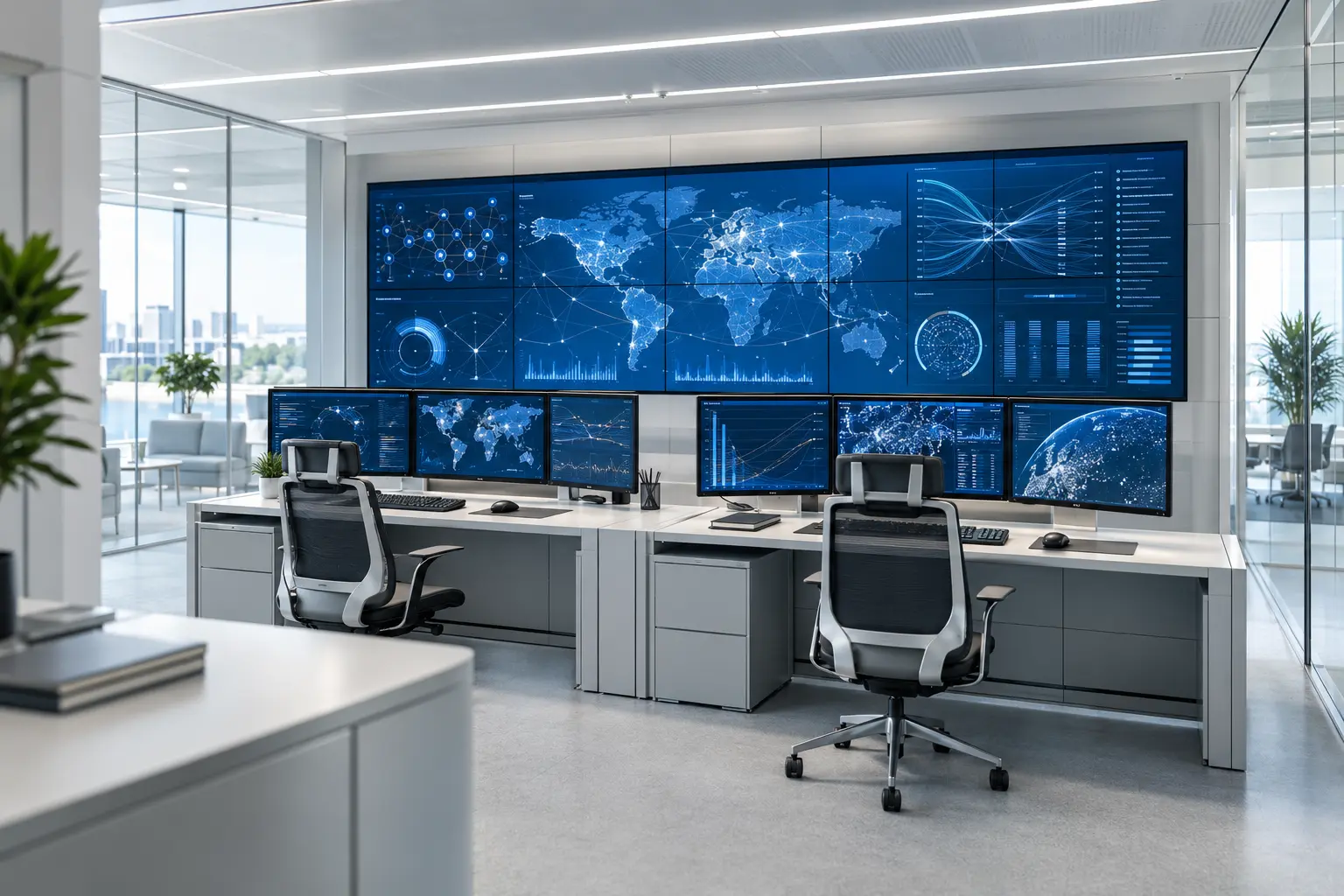
The Fusion Center connects SOC and MDR activities with intelligence, exposure, IT operations and business owners. It can operate virtually or across distributed teams; operational integration is what defines it.

Identities

Endpoints

Cloud

SAP and applications

Cyber Fusion Center

SOC + MDR · Intelligence · Exposure
AI and automation with control

IT operations

Risk and governance

Continuity and recovery

Automated SOC and AI-assisted defense

Automate with judgment.
Respond with control.

Autonomy should grow with evidence quality, validated procedures and a clear understanding of how critical the environment is.

Automated analysis

Context ready for investigation

Signal enrichment, correlation, alert grouping and case preparation for the analyst.

Preauthorized response

Actions within tested boundaries

Bounded and validated procedures with least privilege, activity records and explicit stop conditions.

Human approval

Accountability for critical decisions

Actions affecting production SAP, privileged identities or critical services follow the agreed authorization model.

Every automation needs an owner, a defined scope, evidence, testing and a way to stop it or reverse its effects where feasible.

Technology with business context

Protection should follow the process.

An operation crosses applications, identities and infrastructure. Its controls should too.

SAP

Protect the enterprise core

Roles, technical access, interfaces and change governance connected to the processes SAP supports.

Connect with SAP Operations →
AWS Partner

Clarify your responsibilities

Identities, configurations, logs and recovery within a governed cloud architecture.

Explore cloud operations →
Microsoft

Microsoft
Azure

Connect identity, data and access

Coordinated policies and controls across users, applications and infrastructure resources.

Explore system integration →

Assessment and implementation scope is agreed according to your architecture, licensing and operational responsibilities.

The next decision

AI needs boundaries.
And accountability.

Safe adoption starts with understanding what each solution can access, decide and execute within your business.

Security for AI

Protect what you share.
Control what you delegate.

Extend access and data governance to assistants, models and agents connected to your enterprise systems.

  • Permitted data and authorized sources.
  • Agent identities and permissions.
  • Human approval for sensitive actions.
  • Decision records and suspension criteria.

AI supporting security

More context for decisions.
Oversight for action.

Identify where AI can support findings analysis and response preparation with expert validation.

  • Classification and summaries of findings.
  • Context for affected assets and processes.
  • Support for documentation and procedures.
  • Human review before changes are executed.

Design principle: explicit scope, least privilege, traceable actions and human accountability.

Industry experience

The same incident.
Different consequences.

Protection priorities depend on how each organization produces, delivers and serves. That is why we start with your operating context.

How we start

An assessment that leads to decisions.

Let's define the processes, systems and scenarios worth assessing. The objective is to understand your exposure and agree on what to address first.

  1. An exposure map with context

    Assets, access and dependencies connected to critical processes.

  2. Control priorities

    Findings ordered by impact, urgency and responsibility.

  3. A path to execution

    Actions, owners, dependencies and evidence to track progress.

Let's turn risk into decisions.

Let's discuss the processes and systems your business needs to protect.

Talk to Nexton →

Cybersecurity page sections

Choose a risk scenario

Proposed Cyber Fusion Center model: signals from four domains, defense coordination and connections to operations, risk and recovery

Company